
You type "write an SEO article about water purifiers," hit Enter, and receive 1,500 words that sound… completely generic. The introduction rambles, the headings are cliché, every paragraph claims to be "crucial," and not a single example is usable. The AI isn't incompetent. Your prompt simply didn't tell it what you actually needed.
This guide explains how to write prompts for AI SEO writing so you get exactly what you want on the first draft: an easy-to-remember 6-part framework, a copy-and-paste prompt template, a side-by-side comparison of bad and good prompts for the same keyword, and a checklist to review your article before publishing. Read on, open your favorite AI tool, and follow along in 10 minutes.
30-Second Summary
- AI writes based strictly on what you tell it, not what you think. If information is missing, the AI fills in the blanks using Internet "averages."
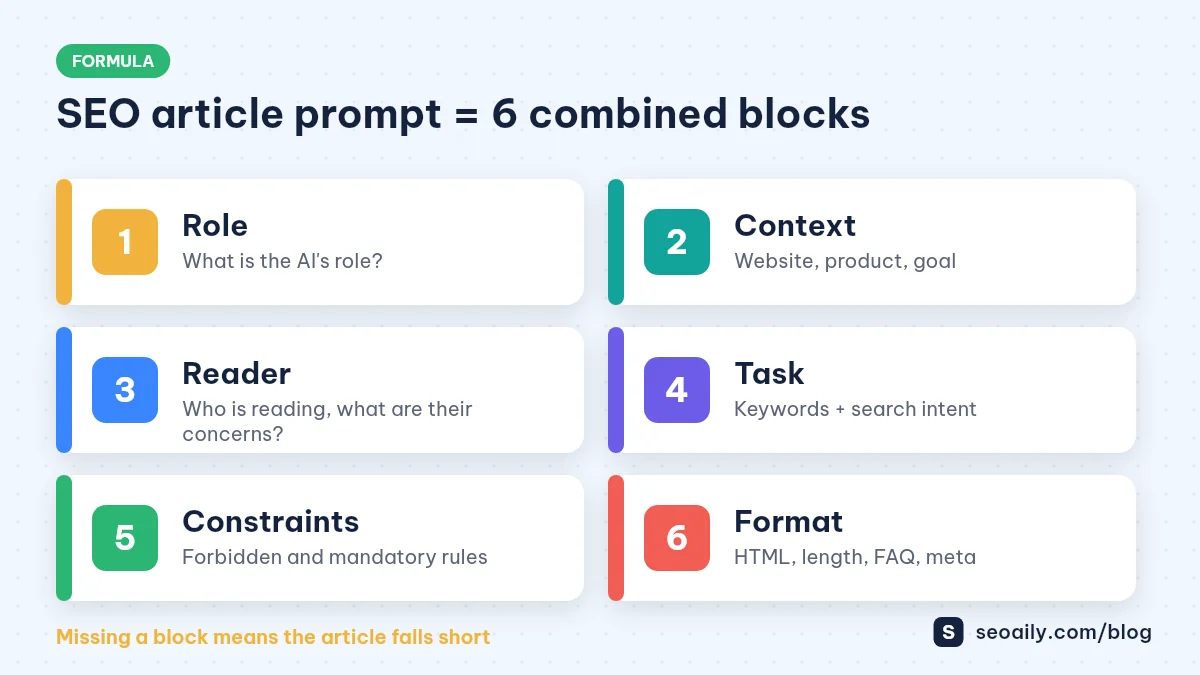
- A great SEO writing prompt contains 6 parts: role, context, audience, task, constraints, and output format.
- Never expect the first draft to be flawless. Treat your prompt like a creative brief and refine it after reading the initial draft.
- Before publishing, always verify: search intent, sourced data, real examples, uniqueness, and a clear CTA.
Why AI SEO Writing Misses the Mark Even When You Explain Carefully
Most AI articles that sound robotic are not due to a weak model. The root cause usually boils down to two factors, both of which can be fixed with better prompting.
AI Doesn't Know What You Haven't Told It
Your head is full of context: what your website sells, who your target buyers are, what competitors are writing, and how your product stands out. The AI cannot see any of that. It only sees the exact text string you type.
When information is missing, the AI doesn't ask clarifying questions. It fills in the blanks with the safest, most generic answer possible—essentially replicating thousands of existing articles. The result is content that is factually "correct" but completely uninspiring, giving Google no reason to rank it above older content.
A One-Sentence Prompt Produces "Average" Content
Imagine hiring a freelance writer and simply texting: "Write an article about water purifiers." That writer has to guess the length, tone, target audience, brand mentions, and pricing comparisons. Ten writers will give you ten different articles, none of which will match your vision.
AI is no different. Shorter prompts yield generic articles. Specific prompts yield content tailored to your publishing goals. Therefore, the best prompting approach is treating your prompt like a brief handed to a skilled writer: rich in context, crystal clear on objectives, and equipped with acceptance criteria.
If you are wondering whether long or short articles perform better, our guide on whether 2000-word SEO articles still work analyzes content length in detail. Here, we focus entirely on the quality of instructions.
How to Write Prompts for AI SEO Writing Using a 6-Part Framework
You don't need to memorize dozens of magic formulas. Just ensure your prompt addresses these 6 core questions. Missing any of them will result in a drop in content quality.
| Component | Answers the question | If missing, the article will… |
|---|---|---|
| 1. Role | Who is the AI pretending to be? | Sound generic and lack professional depth |
| 2. Context | What is the website, product, and goal? | Disconnect from product offerings with awkward CTAs |
| 3. Audience | Who is reading and what is their problem? | Explain concepts at the wrong depth (too basic or too complex) |
| 4. Task | What are the keyword, search intent, and required sections? | Go off-topic and miss essential points competitors cover |
| 5. Constraints | What is forbidden vs. mandatory? | Include fluff, fabricated data, and keyword stuffing |
| 6. Output Format | What structure and format are needed? | Require heavy manual formatting before publishing |
1. Role: Give the AI a Specific Persona
Saying "You are a content writer" is virtually useless. Assign a specific professional background instead: "You are a home appliance consultant with 8 years of hands-on experience installing water filtration systems for residential homes." The more specific the role, the better the AI selects vocabulary, examples, and detail levels.
2. Context: Define Your Website Identity
Clearly state what your website sells, target regions, competitive advantages, and where this piece sits in the buyer's journey. Instructions like "this is for beginners still exploring options, so keep the hard selling light" guide the tone better than a hundred generic reminders.
3. Audience: Write for One Specific Person
Describe a realistic reader: "Sarah, 35, mother of a toddler, worried about sediment in tap water, not technically savvy." The AI will automatically simplify terminology, use everyday examples, and address Sarah's exact concerns. This is the most skipped step, yet it's the key to retaining readers.
4. Task: Keywords, Search Intent, and Core Points
List the primary keyword, a few secondary keywords, and—most importantly—the search intent: are readers looking to learn how to do something, compare products to buy, or find a physical store? Then, list mandatory points to cover. The fastest way is to check the top 5 ranking results, note common points, and add 1–2 unique angles your competitors missed. That unique angle is why Google will choose your piece.
5. Constraints: Dos and Don'ts
This acts as your quality guardrail. Some constraints should be included in every prompt:
- Do not open with cliché phrases like "In today's digital world" or any filler statement that applies to any article.
- Do not include statistical data without a reliable source. If unsure, use qualitative framing.
- Each major section must include at least one concrete example or actionable step.
- Keep paragraphs to a maximum of 3–4 sentences, varying sentence lengths.
- Use keywords naturally without repetitive stuffing.
6. Output Format: Specify What You Want Back
If you plan to publish directly to WordPress, request clean HTML using h2, h3, p, ul, and table tags. If you prefer easy editing, request Markdown. Additional helpful requests include: titles under 65 characters, meta descriptions between 140–160 characters, and 5 FAQs at the end. This eliminates hours of manual formatting later.
Try it now: open your most recent prompt and check if it has all 6 parts. If any part is missing, write an extra sentence for it and run it again. You will notice an immediate difference in the introduction.
Bad Prompts vs. Good Prompts: A Side-by-Side Comparison
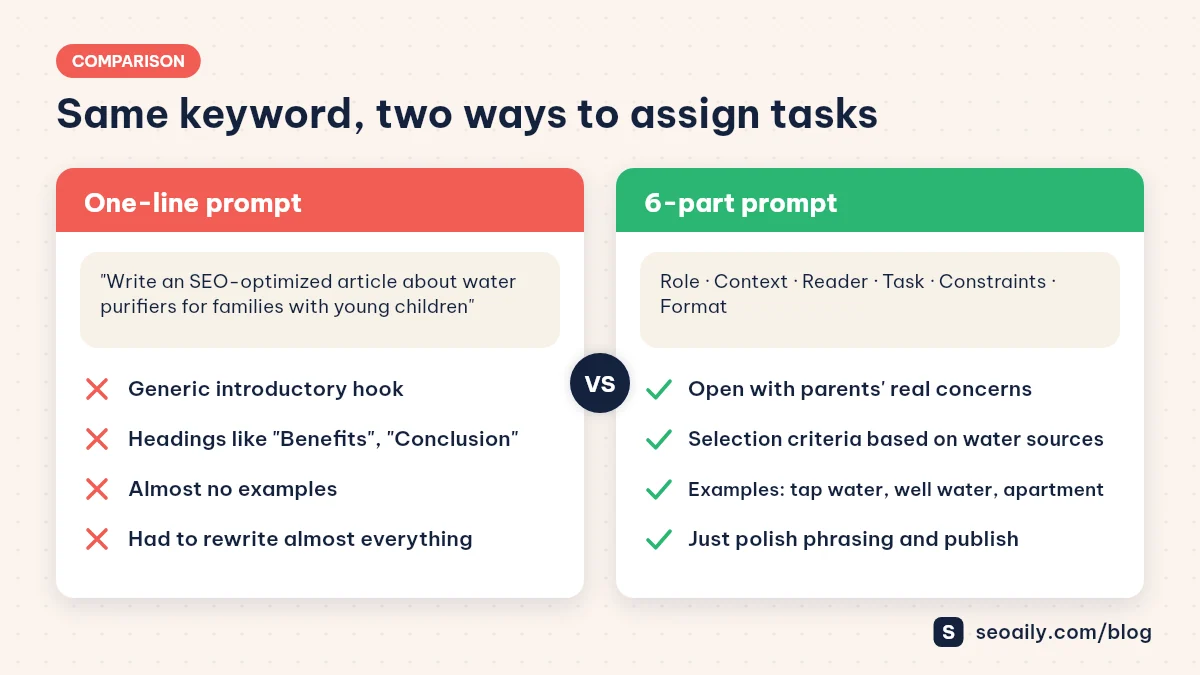
Theory is easily forgotten; examples stick. Using the keyword "best water purifiers for families with kids," let's compare two different briefing approaches.
| Criteria | Bad Prompt | Good Prompt |
|---|---|---|
| Prompt Content | "Write an SEO article about water purifiers for families with kids" | Contains all 6 parts: consulting persona, home appliance website, parent audience worried about water quality, "research-to-buy" intent, mandatory points, constraints, and HTML format |
| Introduction | Generic statements about the importance of clean water | Jumps straight into pain points: "Does your tap water smell like chlorine while you're trying to mix baby formula..." |
| Structure | "What is a water purifier," "Benefits," "Conclusion" | Selection criteria based on water source, filtration technology comparison, filter replacement costs, common mistakes |
| Examples | Hardly any | Specific scenarios based on tap water, well water, and apartments |
| Pre-Publish Editing Effort | Rewriting almost entirely | Minor wording tweaks and adding personal brand experiences |
The biggest differentiator isn't the length of the prompt, but the fact that a good prompt preemptively answers questions the AI would otherwise have to guess. Removing guesswork eliminates generic writing.
Ready-to-Use SEO Article Prompt Template
Here is a customizable prompt framework you can paste into any AI tool. Replace the bracketed information with your own details. Do not delete any lines, even if they seem redundant: every single line blocks a common AI error.
ROLE: You are an [industry expert, X years of experience, specific past background].

CONTEXT: Website [name] sells/provides [products, services] for [region, audience].
Unique differentiator: [1-2 points]. Article goal: [educate / compare / guide to product page].

AUDIENCE: [Describe 1 specific person: age, situation, anxieties, knowledge level].

TASK: Write a blog post targeting the primary keyword "[keyword]".
Secondary keywords: [3-5 phrases]. Search intent: [learn how / compare / buy].
Must include: [point 1], [point 2], [point 3], [unique angle competitors missed].

CONSTRAINTS:
- Introduction jumps straight into the reader's problem in maximum 3 sentences.
- No empty clichés, no fabricated statistics; any data cited must be sourced.
- Every H2 section must include at least 1 concrete example or actionable step.
- Paragraphs max 4 sentences. Use primary keyword naturally 3-5 times.

FORMAT: HTML output using h2, h3, p, ul, table. Length around [number] words.
Include: Title under 65 chars, meta description 140-160 chars, 5 FAQ questions.
An example of filling out the AUDIENCE section for an English teaching website: "Alex, 28, office worker, wants to take the IELTS exam in 4 months, has only 1 hour to study every night, and previously tried self-studying but gave up." With this single sentence, the AI knows to focus on a short study roadmap, time-saving strategies, and motivation building.
Tip: Save this framework as a permanent note. Every time you write a new article, filling out these 10 lines takes minutes but saves you hours of post-editing work.
Refining Your Prompt After the First Draft
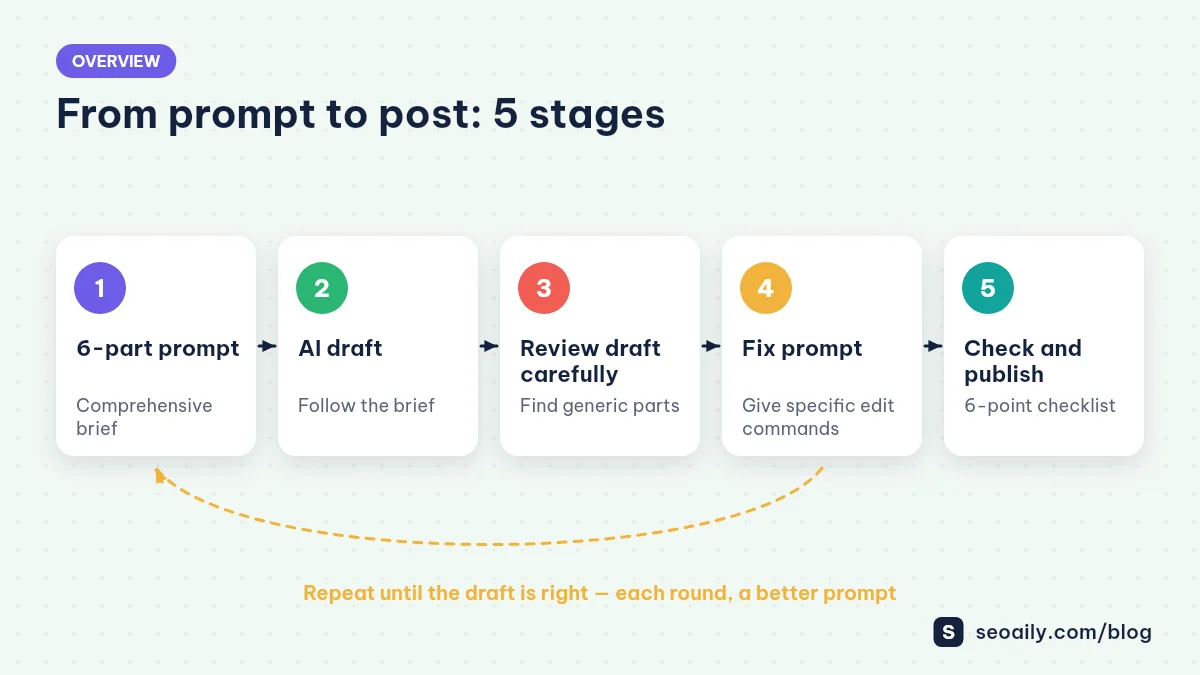
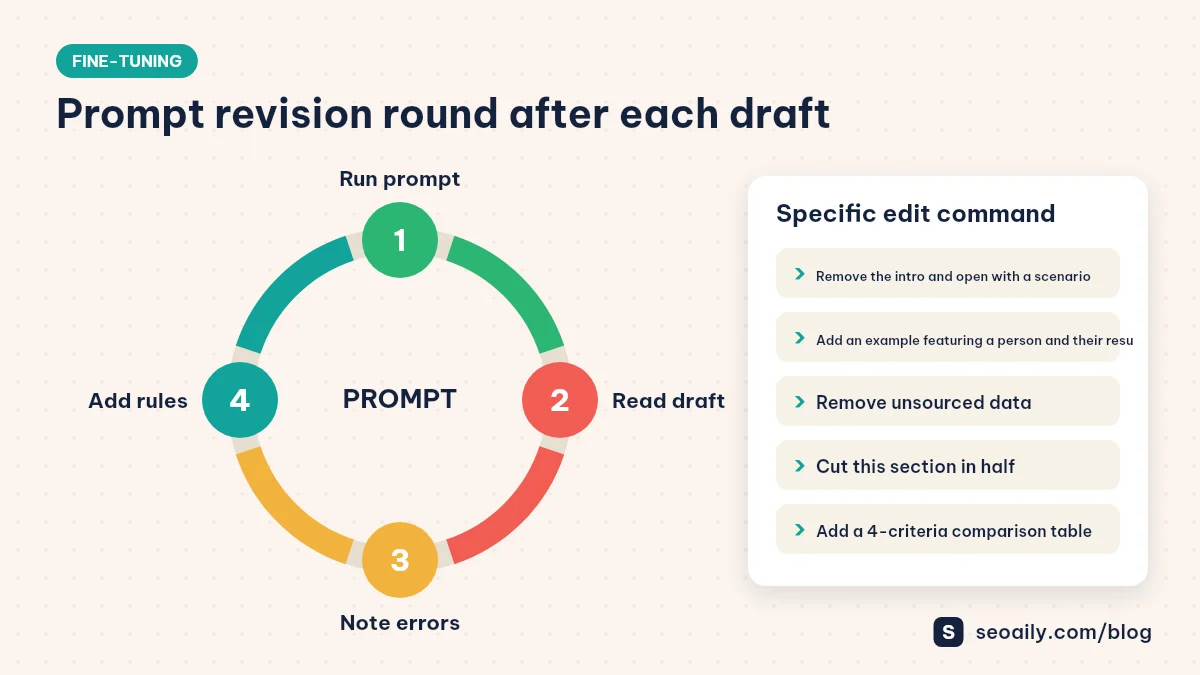
Even great prompts rarely produce a flawless article on the first try. Skilled content creators don't write one-shot prompts; they excel at targeted prompt refinement after reading the first draft.
Read the Draft Like an Editor, Not an Author
When reviewing a draft, ask yourself three questions: Do readers get what they came for within the first 3 paragraphs? Can any paragraph be deleted without losing value? Are there clichés that any competitor could have written? Every "yes" points to an edit that belongs in the prompt, not just the text.
Helpful Revision Commands
Instead of vague instructions like "make it sound better," issue specific commands for specific issues:
- "Rewrite the introduction: remove generic filler and open with the reader's specific situation."
- "The [section name] section is too generic. Add a specific scenario featuring real context and results."
- "Find and remove all unsupported numbers. Replace them with qualitative descriptions."
- "Condense the [section name] section by half while retaining actionable steps."
- "Add a comparison table for [A] and [B] based on 4 criteria: cost, difficulty, timeframe, and target user."
After 2–3 articles, you'll notice recurring adjustments. Permanently add those adjustments to the CONSTRAINTS section of your template. Your prompts will continuously improve—giving you an advantage single-prompt users will never match.
7 Pitfalls That Cause SEO Prompts to Fail
These are the most common mistakes found when reviewing prompts that failed to generate satisfying content.
- Supplying keywords without search intent. For the same keyword, searchers might want to learn, compare, or buy. Without clarity, AI blends all three.
- Demanding "SEO optimization" without defining what that means. Be specific: heading structures, word counts, mandatory points, and FAQs.
- Overloading with secondary keywords. 3–5 phrases are enough. Dozens will make the copy stiff and disjointed.
- Failing to ban fabricated numbers. AI loves inventing plausible-sounding statistics. A single wrong number destroys trust.
- Omitting tone of voice guidelines. "Friendly as a fellow trade expert" sounds completely different from "formal as an institutional report."
- Asking AI to write overly long articles in one pass. For comprehensive guides, break it down: outline generation, outline review, and section-by-section writing.
- Publishing without reading. Great prompts reduce editing time, but they cannot replace a human review step.
Pitfall #6 happens often when scaling content clusters. If you are building topic clusters, read our guide on what content clusters are and how to build them to map out outlines before drafting individual pieces.
Pre-Publishing Checklist for AI Articles
Is your article ready? Spend 10 minutes running through this list to avoid common reasons why AI content fails to rank well.
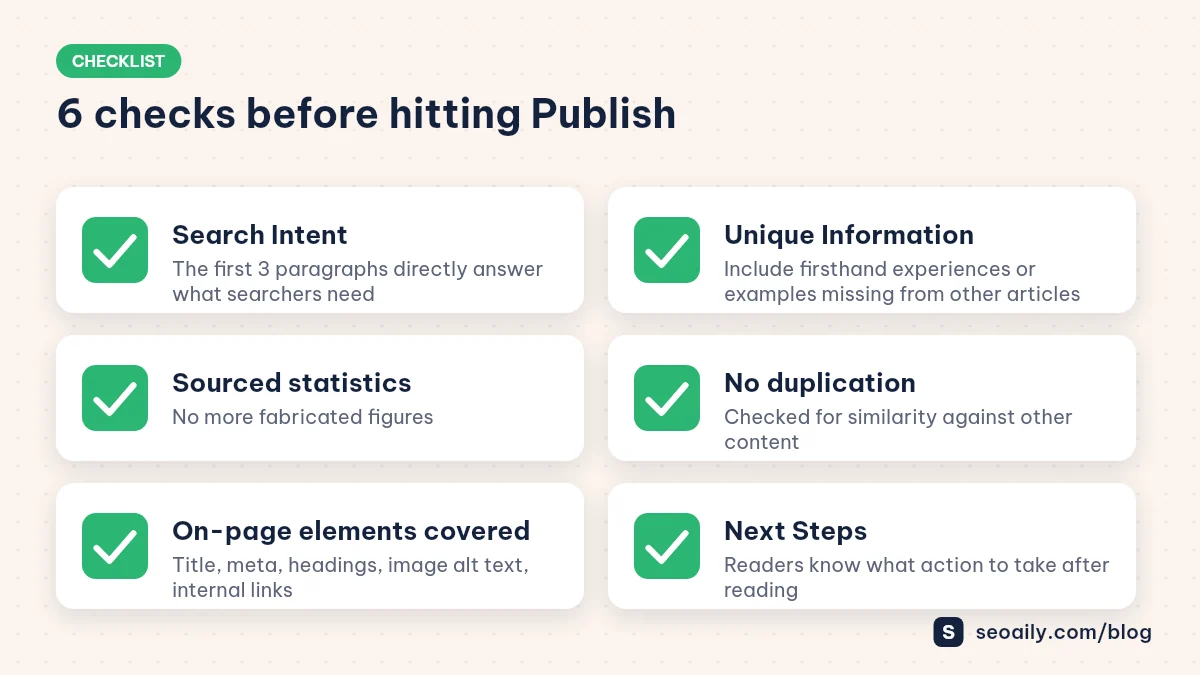
- Search Intent: Do the first 3 paragraphs directly answer what searchers came to find?
- Unique Insights: Does the article feature at least one experience, example, or perspective competitors lack?
- Data Verification: Are all numbers backed by verifiable sources?
- Uniqueness: Have you checked for content overlap? See how in our guide on how to check for duplicate content effectively for SEO.
- On-Page SEO: Are titles, meta descriptions, headings, image alt texts, and internal links fully optimized?
- Next Actions: Do readers know what to do next after finishing the article?
Google does not penalize content simply because it is AI-assisted. Google evaluates whether content is helpful, reliable, and human-centric, as outlined in Google Search Central's guide on AI-generated content and documentation on creating helpful, reliable, people-first content. Good prompting helps you hit those quality standards right from the start.
Publishing isn't the finish line. After roughly a month, check rankings and CTR, following tips from our guide on how to measure article performance after 30 days. Real data will guide how you refine your prompts for future articles.
Frequently Asked Questions
How long should an AI prompt be?
There is no fixed length. A prompt is long enough when it covers all 6 key parts: role, context, audience, task, constraints, and format. Usually, 10–20 lines is optimal. Making it longer without adding new information will only confuse the AI.
Will Google penalize AI-generated SEO articles?
Google clarifies that they evaluate content quality rather than penalizing content simply because AI assisted in creating it. The real risk lies in generic, low-value, mass-produced content. A solid prompt combined with human editing minimizes that risk.
Should I ask AI to write an entire article in one go?
For short pieces, yes. For long-form articles, break down the process: let AI suggest an outline, review and edit it, and then write section by section. This maintains narrative flow and prevents repetition.
How can I prevent AI content from sounding generic?
Include elements in your prompt that only you possess: real-world experiences, internal data points, frequent customer questions, and your unique product perspective. AI cannot invent these elements, making them your strongest differentiator.
Can I reuse the same prompt for multiple articles?
Yes, and you should. Keep the role, context, constraints, and format sections fixed. Change only the audience and task per article. Over time, append manual corrections you've made to your prompt constraints so you never repeat mistakes.
Conclusion: A Good Prompt Is a Great Brief
Learning how to write prompts for AI SEO writing requires no secret tricks—just delegating tasks as clearly as you would to a skilled human writer. Include all 6 parts, provide examples, set constraints, outline acceptance criteria, and patiently refine prompts after each draft. Do this across a few pieces, and you will build a proprietary prompt library that no one can copy.
If you want to bypass manual prompt building altogether, try Seoaily. Simply enter a keyword, and the system automatically generates outlines, drafts SEO-structured content, and scores on-page optimization against 23 criteria so you know what to tweak before publishing. Try Seoaily for free and compare it with the articles you write using your own prompts.