
The Truth About Long-Form Content: Do 2000-Word Articles Still Work for SEO?
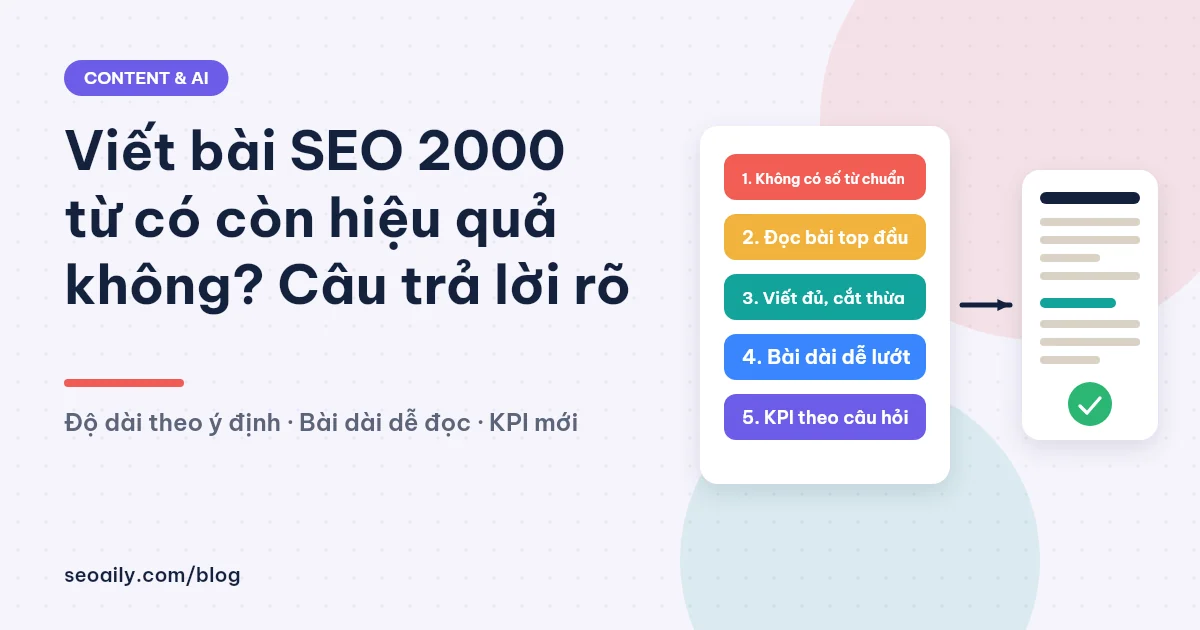
Many content teams and SEO managers still assign strict word count targets, assuming that every blog post must hit at least 2,000 words. The logic seems straightforward: longer content covers more ground, so Google must prefer it. However, inflating word count without prioritizing user experience can actually hurt your search rankings.
So, do 2000 word articles still work for seo today? The answer isn't a simple yes or no. Word count itself has never been a direct Google ranking factor. When long-form posts dominate page one, it is usually because they comprehensively satisfy the searcher's query—not because they hit an arbitrary word count metric.
Ahrefs research on content length consistently shows a strong correlation between detailed topical coverage and higher search rankings. The key takeaway is information depth, not fluff.
How Google's Helpful Content System Changed the Rules
Google launched its Helpful Content System specifically to demote content designed primarily to manipulate search engines. In its official documentation on Google's helpful content guidelines, search engineers emphasize building people-first content.
If you stretch out an article with repetitive paragraphs just to hit 2,000 words, Google's algorithms will likely flag it as low-quality. Readers who land on wordy, unhelpful pages leave immediately. High bounce rates and short dwell times signal to search engines that your page failed to deliver value, leading to rank drops across target keywords.
High-Value Long Content vs. Fluffy Word Count Inflation
A valuable 2,000-word SEO article solves a reader's problem from start to finish. It offers original data, expert insights, actionable steps, and direct answers to related questions. After reading it, users don't need to return to Google to search for more information.
In contrast, fluffy long-form content relies on wordy introductions, redundant statements, or explanations of basic concepts your target audience already understands. For example, if you write a guide on buying professional camera lenses, spending 500 words defining "what is a camera" wastes the reader's time and harms engagement metrics.
When to Write a 2000-Word Article vs. Short Content
The ideal content length depends entirely on the search query. To figure out if a 2,000-word post makes sense for a specific keyword, start by analyzing the current Search Engine Results Page (SERP).
If the top five ranking pages answer the query effectively in 800 to 1,000 words, you don't need to force a 2,000-word post. However, if the topic demands detailed technical breakdowns, step-by-step instructions, or deep comparisons, a 2,000+ word article becomes essential to outrank existing competitors.
Search Intent Dictates Article Length
Search intent generally falls into four main categories: Informational, Navigational, Commercial Investigation, and Transactional. Each intent type demands a distinct content structure and length.
For broad informational queries like "complete guide to technical SEO," users expect an in-depth resource. A 2,000-word article excels here because it provides enough room for screenshots, examples, and comparison tables. On the flip side, for transactional queries like "buy iPhone 15 Pro Max online," users just want pricing and purchase links—a 2,000-word essay here will frustrate users and hurt conversion rates.
Recommended Content Length by Article Type
Use the following breakdown to determine appropriate content lengths based on intent and format:
| Article Type | Search Intent | Recommended Length | Primary Goal |
|---|---|---|---|
| Ultimate Guide | Deep Informational | 2,000 – 3,500 words | Cover every aspect of a subject to serve as a long-term reference piece. |
| Product Review / Comparison | Commercial Investigation | 1,500 – 2,500 words | Provide pros/cons, pricing tables, and hands-on testing data to guide decisions. |
| News & Event Updates | Quick Informational | 500 – 800 words | Deliver accurate, timely updates on current news or events. |
| Service / Landing Page | Transactional | 800 – 1,200 words | Highlight user pain points, showcase solutions, build trust, and drive CTAs. |
Learn more: Seoaily blog.
How to Optimize 2000-Word SEO Articles for Rankings and Engagement
Writing 2,000 words is only half the battle. Making those 2,000 words readable and engaging is what keeps users on your page. When viewing long posts on mobile devices or desktop screens, readers quickly fatigue if presented with walls of text.
To optimize long-form articles, combine strategic content formatting, rich visual assets, and clean user experience design. This improves overall dwell time—a key signal for modern search performance.
Content Structuring Techniques That Reduce Bounce Rates
A well-structured long article allows readers to quickly scan headers and locate the exact section they need. Apply these formatting best practices:
- Add an Interactive Table of Contents: Allow users to jump directly to target subtopics without scrolling endlessly.
- Break Text with H2, H3, and H4 Tags: Keep sections under H2 headings brief (2-3 paragraphs max) to avoid visual overload.
- Keep Paragraphs Short: Limit paragraphs to 3 or 4 sentences. Alternate sentence length to maintain a natural reading rhythm.
- Use Bullet Lists and Data Tables: Convert complex steps or datasets into scannable lists and structured tables.
- Include Key Takeaway Boxes: Place brief summary boxes beneath core H2 sections for busy skim-readers.
On-Page SEO and UX Tweaks for Long Articles
Proper on-page optimization helps search crawlers understand the contextual depth of your 2,000-word article. Distribute primary and target LSI (Latent Semantic Indexing) keywords naturally across headings, introductory paragraphs, and summary conclusions.
Visual media is equally critical in long-form posts. Insert a relevant, compressed image with descriptive ALT text roughly every 300 to 400 words. Images break up text blocks while opening up ranking opportunities on Google Images.
Learn more: how to check for duplicate content.
Learn more: user guides.
Frequently Asked Questions
Are 2000-word SEO articles required for every keyword?
No, content length depends heavily on user search intent and keyword competition. Some queries only require 800 words if the answer is straightforward. Always analyze top-ranking competitors on the SERP to determine the appropriate length rather than blindly sticking to a 2000-word target.
Does writing long content increase website bounce rates?
Long articles only increase bounce rates if the content is fluffy, poorly structured, or lacks clear navigation. If your post uses subheadings (H2, H3), concise paragraphs, and helpful visuals, long-form content actually boosts user dwell time.
Should I write 2000-word articles manually or use AI tools?
Combining both yields the best results. AI accelerates outlining and drafting, while human SEO specialists verify data accuracy, inject firsthand experience, and refine tone of voice. This hybrid approach ensures optimal length while satisfying Google's E-E-A-T guidelines.
How can I verify if my 2000-word article is properly optimized on-page?
You can use automated On-Page SEO scoring tools to inspect keyword density, heading structure, internal links, and readability. Automated checks help catch technical oversights before publishing.
Does writing longer content help capture traffic from secondary keywords?
Yes, this is one of the biggest benefits of writing 2000-word articles. Covering a topic in depth naturally incorporates dozens of related terms and long-tail keywords, allowing a single article to rank for hundreds of search queries and drive significantly more overall traffic.
Learn more: single-keyword article generator.
Learn more: SEO workflow for new websites.
Streamline Your Long-Form Content Production with Seoaily
In conclusion, 2,000-word articles remain highly effective when they prioritize helpful depth, align with search intent, and deliver an outstanding user experience. However, performing keyword research, outlining topics, and writing fully optimized long-form pieces manually requires significant resources.
If you want to speed up production while maintaining high editorial standards, leverage Seoaily. The platform generates comprehensive, search-optimized articles from a single target keyword—automatically auditing competitors, building logical outlines, and evaluating on-page performance directly inside your workspace.
Stop letting long-form content creation bottleneck your organic growth. Start a free trial of Seoaily today and see how effortlessly you can publish high-ranking long-form content!