
You finish writing an article, skim through it, think it looks great, and hit publish. A month later, it is stuck on page 3 of Google. Upon closer inspection, the title is truncated, the intro fails to answer the main search query, and there isn't a single internal link. These flaws take minutes to fix—if you catch them before publishing.
This guide explains how to use a 100-point SEO content scorecard divided into 5 core groups: search intent, on-page SEO, readability, links & visuals, and trustworthiness. You will also get a ready-to-use template and clear guidelines on whether to publish, edit, or rewrite based on your score.
30-Second Summary
- Scoring articles pre-publishing catches cheap errors before Google penalizes them.
- Search intent and content depth carry the most weight; technical factors are necessary baseline conditions, not everything.
- Recommended weightings: 30 points for intent/content, 25 for on-page SEO, 20 for readability, 10 for links/visuals, and 15 for trust.
- Scores of 85+ are ready to publish; 70–84 need targeted edits; under 70 require a structural rethink.
Why You Should Score Articles Before Publishing
Fixing content after publishing forces you to wait for Google to re-crawl and re-evaluate your page. Fixing it beforehand takes just a few minutes. Establishing a standard checklist converts subjective proofreading into an objective process that yields consistent results across your team.
Achieving a high score isn't about gaming the algorithm. Google ranks content based on real utility to searchers, as outlined in Google's helpful content guidelines. A scorecard simply ensures you don't overlook critical elements you already know matter.
How to Score Content with a 100-Point SEO Content Scorecard
The framework below provides a balanced baseline based on impact on users and search engine understanding. Feel free to adjust weightings to match your site's specific niche.
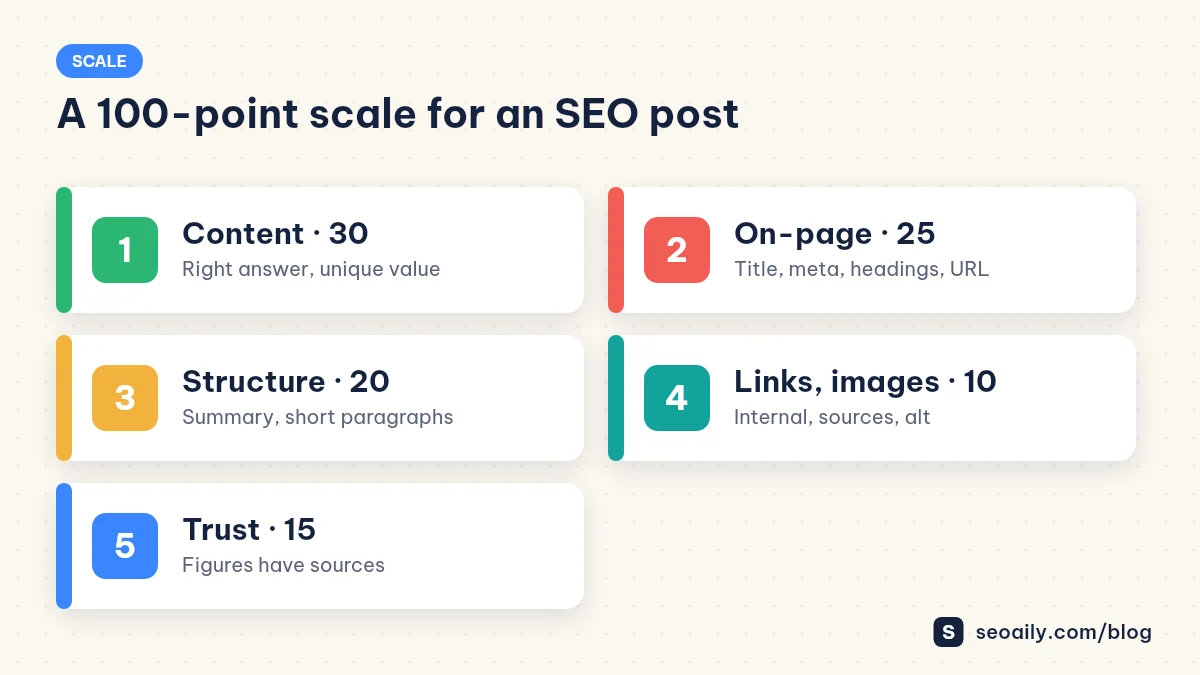
| Category | Max Points | What to Evaluate |
|---|---|---|
| Search Intent & Value | 30 | Directly answers search query, offers unique insights, matches top SERP depth |
| On-Page SEO | 25 | Title tag, meta description, headers, natural keywords, clean URL slug |
| Readability & Layout | 20 | Direct introduction, short paragraphs, logical headers, tables, lists |
| Links & Visuals | 10 | Relevant internal links, trustworthy external sources, descriptive alt text |
| Trustworthiness (E-E-A-T) | 15 | Verifiable stats, factual accuracy, no deceptive claim language |
Group 1: Search Intent & Content Value (30 Points)
This is the most critical category. Evaluate three questions: Do the first three paragraphs directly address what the user searched for (10 pts)? Does the article offer something top competitors lack, such as first-hand experience or concrete data (10 pts)? Does it cover secondary questions searchers naturally have (10 pts)?
Group 2: On-Page SEO (25 Points)
The title tag must contain your target keyword without exceeding pixel length limits. The meta description should clearly summarize the value proposition. Keywords should appear naturally in the opening paragraph and at least one H2. The URL slug should be clean and concise. Core best practices are detailed in Google's SEO Starter Guide.
Group 3: Readability & Structure (20 Points)
Start with a clear summary for skimmers. Paragraphs should stay under 3–4 sentences. Subheadings must be descriptive rather than generic, and complex data comparisons should use structured tables. Mobile users scan before they read, so your layout must be effortless to scan.
Group 4: Links & Visuals (10 Points)
Include contextual internal links to related articles on your site. Cite authoritative external sources whenever presenting claims or data. Images must include descriptive alt text that aids comprehension, not just serve as decorative fillers.
Group 5: Trustworthiness & Accuracy (15 Points)
All statistical claims must link to primary sources. Product details, pricing, and feature mentions must be accurate as of publication. Avoid exaggerated guarantees like "guaranteed #1 ranking." For YMYL (Your Money or Your Life) topics, strict accuracy is non-negotiable.
Quick Test: Take your latest published post and spend 3 minutes scoring Group 1 only. If it scores below 20/30, revising your content angle will deliver far better results than tweaking technical tags.
Ready-to-Use SEO Content Scorecard Template
Copy and paste this text scorecard into your content workflow notes or spreadsheet to evaluate articles quickly.
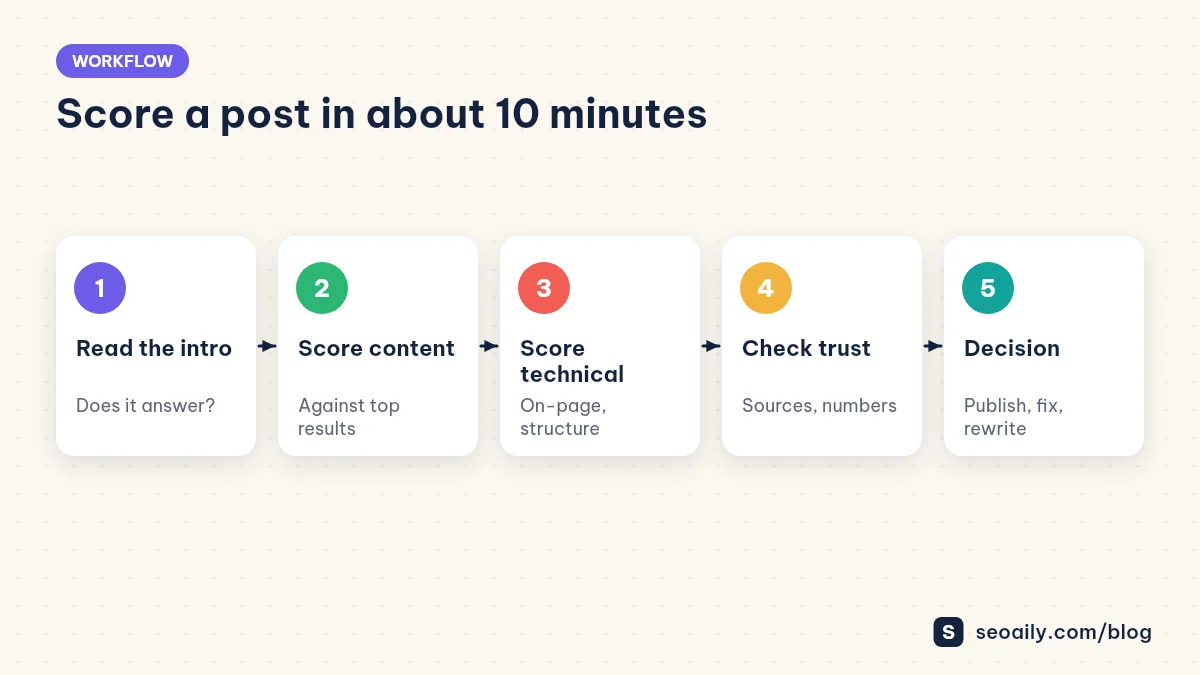
ARTICLE TITLE: [Title]                      TARGET KEYWORD: [Keyword]

1. INTENT & VALUE (30)
   [ /10] First 3 paragraphs answer the main query directly
   [ /10] Provides unique value (case study, expert insight, data)
   [ /10] Answers logical follow-up questions better than top SERPs
2. ON-PAGE SEO (25)
   [ /7] Title tag includes target keyword and avoids truncation
   [ /6] Meta description contains clear value and target keyword
   [ /6] Keyword appears naturally in intro + at least 1 heading
   [ /6] Clean, descriptive URL slug
3. READABILITY & STRUCTURE (20)
   [ /5] Direct intro with quick summary block
   [ /5] Short paragraphs (3-4 sentences max), clear sentences
   [ /5] Descriptive, scannable H2/H3 subheadings
   [ /5] Tables or lists used where appropriate
4. LINKS & VISUALS (10)
   [ /4] Contextual internal links to relevant content
   [ /3] External links to authoritative sources for statistics/claims
   [ /3] Images have helpful alt text and clear captions
5. TRUSTWORTHINESS (15)
   [ /8] All claims backed by sources; facts accurate
   [ /7] No exaggerated promises or misleading claims

TOTAL SCORE: [   /100]   DECISION: [Publish / Edit / Rewrite]
Interpreting Scores: Publish, Revise, or Rewrite?
Your overall score determines your next step, while individual group scores highlight where to direct your editing efforts.
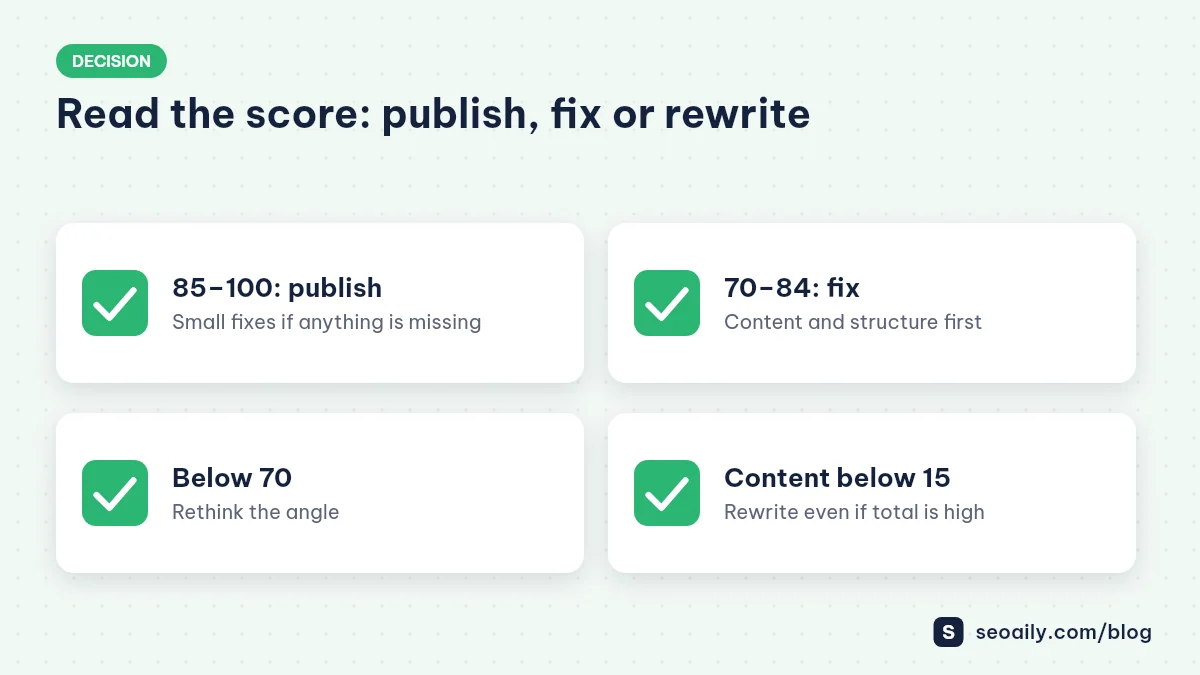
| Score | Decision | Priority Action |
|---|---|---|
| 85–100 | Publish | Make minor tweaks to any missed checklist items |
| 70–84 | Edit then Publish | Fix low-scoring areas—typically Intent (Group 1) or Readability (Group 3) |
| Below 70 | Re-evaluate Angle | Rethink search intent and unique value before fixing technical SEO |
| Group 1 < 15/30 | Rewrite | Even with perfect on-page SEO, wrong search intent won't rank |
Example: Evaluating a 76-Point Article
Consider an article titled "How to Choose a Home Water Filter." It scores 18/30 on Search Intent because the intro spends two paragraphs on general background before answering the question. On-Page SEO scores 22/25, Readability 17/20, Links & Visuals 7/10, and Trustworthiness 12/15 due to an unsourced statistic on filter lifespan. Total score: 76 points ("Edit then Publish").
The editor only needs to make two adjustments: move the core answer into the opening paragraph and cite the missing statistic source. After these targeted fixes, the score jumps above 85 without rewriting any other sections. That is why category-based scoring works better than a single aggregate number.
Pro Tip: Have team members peer-review each other's work. Writers tend to score their own articles generously—especially in intent and unique value—whereas a fresh reader immediately spots fluff or missing answers.
High-scoring articles should still undergo a final originality check using our pre-publishing duplicate content checklist. If you publish on WordPress, check out our practical guide to optimizing WordPress SEO posts step-by-step.
6 Common Scoring Pitfalls to Avoid
- Focusing strictly on technical SEO. An article packed with target keywords and header tags will still fail if it misses search intent.
- Chasing a perfect score at the expense of natural tone. Forcing extra keywords just to boost on-page metrics ruins readability.
- Scoring after publishing. Post-launch revisions delay indexation updates and cost extra time.
- Using inconsistent criteria across team members. Without a defined point allocation, scores will vary wildly by editor.
- Ignoring factual trust signals. Unverified statistics damage your site's domain credibility and user trust.
- Failing to track performance against scores. Keep records to verify whether higher-scoring posts actually outperform lower-scoring ones over time, following our guide on measuring content performance after 30 days.
Final Checklist Before Clicking Publish
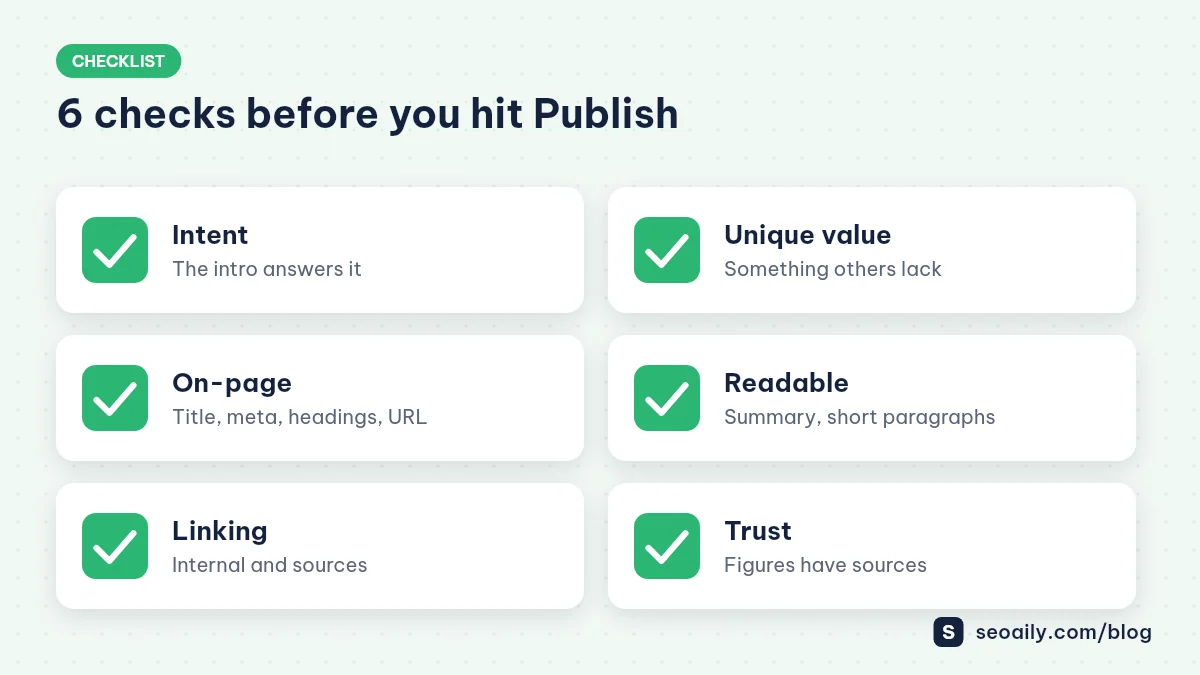
- Search Intent: Do the first three paragraphs answer the core question?
- Unique Value: Does the article add insights missing from top competitor posts?
- On-Page SEO: Are title, meta description, headers, and URL slug optimized?
- Readability: Is there a quick summary, short paragraphs, and clear formatting?
- Links: Are internal links present and statistics cited with external sources?
- Trust: Are all data points verified and accurate?
Frequently Asked Questions
What score guarantees a top-ranking article?
No score guarantees a #1 spot on Google. Rankings also depend on domain authority, backlink strength, and keyword competitiveness. Scoring ensures your content doesn't lose rankings due to avoidable technical or structural mistakes.
Should I rely entirely on automated scoring tools?
Automated tools excel at validating technical items like character counts, keyword density, and broken links. However, assessing intent match, nuance, and original value still requires human review.
Should existing articles be re-scored?
Yes. Re-evaluating underperforming content—especially pages stuck on page 2 of SERPs—helps identify exact gaps to fix rather than needlessly rewriting the entire article.
What is the ideal keyword density?
There is no target percentage. Your primary keyword should appear naturally in your title, meta description, introductory paragraph, and key subheadings. If a phrase feels awkward to read aloud, it is over-optimized.
How long does it take to evaluate an article?
Using a standard template, a full review takes about 10 minutes. Once you are familiar with the workflow, on-page and layout checks take seconds, leaving most of your time for assessing content depth and intent.
Conclusion: Score First, Publish Second
Using a standardized SEO content scorecard before publishing ensures your content satisfies user intent, adheres to technical standards, and delivers real value. Spending 10 minutes grading content today saves weeks of troubleshooting stagnant search rankings later.
Want to automate your on-page checks directly inside your editor? Try Seoaily: our AI writing platform evaluates 20+ on-page SEO criteria and highlights fixes before you publish. Try Seoaily for free today.